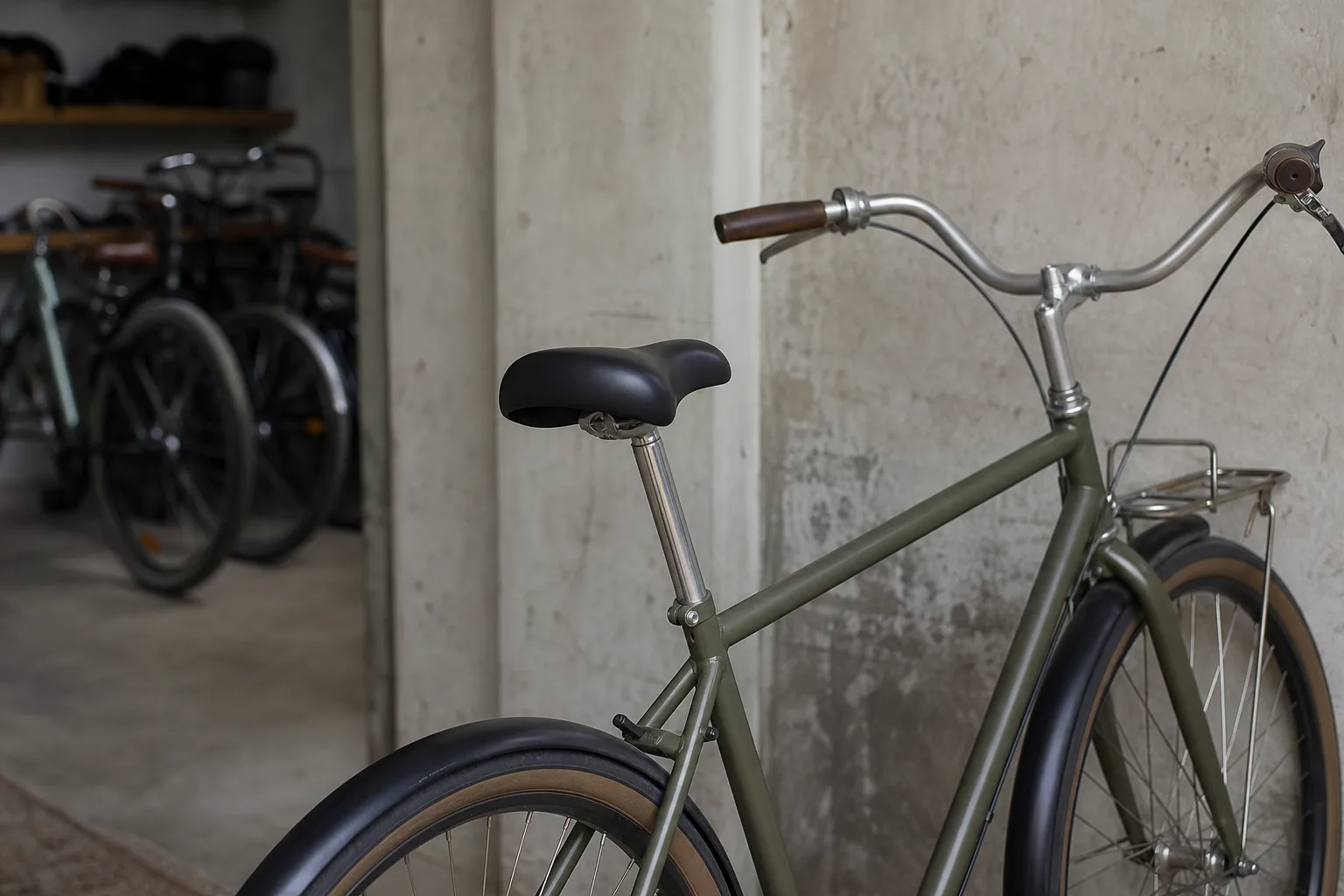
Sit on an upright, wide-tyred bicycle in a shop and the appeal is immediate, because almost nothing is being asked of you: your hands fall onto the bars without reaching, your back stays vertical, and the saddle is wide enough that you notice it as furniture rather than as equipment. That first impression is accurate about the first three miles and misleading about the tenth. The geometry that makes a low-speed ride feel effortless is the same geometry that concentrates load in one place, and the cost of that concentration shows up on a timescale most test rides never reach.
Where your weight actually goes
On a road or hybrid frame, your mass is split across three contact points, with a meaningful share carried by your hands and a further share taken by the muscles of your legs and core as you lean forward against the pedals. Sit upright and that changes. A seat tube laid back toward the rear wheel puts the saddle behind the bottom bracket rather than above it, so your pelvis sits farther aft and your torso stacks vertically over it. The result is that something in the range of two-thirds to three-quarters of body weight lands on your seat bones, with the hands doing little more than steering.
Swept bars complete the arrangement. Pulling the grips back toward the rider shortens the effective reach, which means the arms do not have to hold the torso up at all, and the shoulders relax into a position closer to standing than to riding. Wide tires at low pressure and a sprung saddle then absorb the vibration that the arms are no longer damping. Each of those choices is defensible on its own. Together they build a bicycle that carries you rather than one you ride, and that distinction is the whole subject.
Why it feels right at low speed
Under about ten miles per hour, air resistance is a small part of the total load, so the aerodynamic penalty of sitting up costs you almost nothing you would notice. Sight lines improve, because your eyes are higher and your head is level rather than craned. Balance at walking pace is easier with a long wheelbase and a slack head angle, which is why these frames feel stable rolling out of a driveway, threading a boardwalk, or stopping and starting through a beach town at the pace of foot traffic. The Beach Cruiser layout was built around exactly that use, and it does it better than anything else at the price.
Comfort at that speed is also a function of how little skill the position demands. You are not managing a reach, not holding a hover over the saddle through rough pavement, not shifting weight forward and back to unload the rear wheel. Riders returning to bicycles after twenty years away, riders with wrist problems, and riders who simply want to get somewhere two miles off without changing clothes all benefit from a machine that asks for no technique. That is a real engineering achievement and not a compromise, provided the ride ends before the position starts charging interest.
The point where the same geometry hurts
Somewhere between forty minutes and ninety minutes, depending on your weight, the saddle, and how smooth the route is, the concentrated load on the seat bones stops being distributed pressure and starts being a hot spot. Because your hands carry almost nothing, you cannot shed load by standing on the pedals or by shifting to a second hand position, and the sprung saddle that smoothed small bumps does not change where the weight sits. At the same time, the laid-back seat tube puts your hips behind the pedals, which limits how much power the glutes can contribute, so any headwind or grade you meet is met with the quadriceps alone.
Lower back tightness follows for many riders, since a vertical spine takes road shock as compression rather than passing it through flexed hips and arms. None of this is a defect. It is the predictable other end of the same trade, and it defines the range of the machine honestly: excellent to about five miles, workable to eight or ten on flat pavement, uncomfortable beyond that in a way no accessory reliably fixes. Knowing that number before you buy is worth more than any spec sheet comparison.
What the decision costs, and who should make it
The money is the smaller part. A steel cruiser typically lands well under what a comparable hybrid costs, and the parts are common, so a shop can service one anywhere. The real cost is range. If your riding is errands within a couple of miles, a waterfront path, a campus, or a flat neighborhood grid, you give up almost nothing, because you were never going to use the capability you are trading away. If you are hoping to build toward a fifteen-mile weekend loop, or you live anywhere with sustained grades, a hybrid or a flat-bar road bike will cost more and reward you more. The Consumer Product Safety Commission is responsible for the federal requirements that govern how bicycles are built and sold in the United States, but no regulator can tell you which geometry matches your route.
Ride the exact bike for at least half an hour before money changes hands, on the surfaces you actually use, and pay attention to the last ten minutes rather than the first ten. If the answer is that you were still comfortable, you have found the right tool and can stop looking.